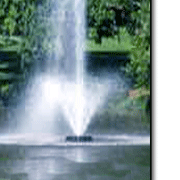
Spring into Ponds
A little time spent on your pond this spring will pay huge dividends
later this summer. The pond and its associated flora and fauna,
is reviving from a dormancy period. Over winter much, if not all,
of the oxygen in the pond has been consumed and depleted. With
ice melt, two important changes occur. Surface water mixes with
the air on windy days to start re-oxygenating your pond. It could
take some time for the oxygen to reach the deeper points, if at
all. Without ice cover, sunlight can again penetrate deeper into
the water column. Initially after the ice melt, the pond water
can
be crystal
clear but after a few weeks of sunlight penetration, pond waters
can turn to shades of green and brown.
There are a few important jobs a pond owner can initiate early
in spring. Firstly, if you have an aerator re-install it. If you
don’t have an aerator think of purchasing one, as it is the
best single investment a pond owner can make. Maximizing the
oxygen in your pond will help to oxidize many of the nutrient rich
bottom sediments which can cause summer vegetative growth. An aerator
distributes oxygen much more efficiently and effectively than the
wind.
Take an hour or so and clean the perimeter of your pond of all
those goodies (leaves, twigs, trash, etc.) that blew in last fall
and winter. A pond net is a very useful tool in performing this
task quickly and effectively. Trim back and remove dead cattails,
bulrushes, etc. If there is a problem with submergent vegetation,
early spring is the best time to apply the sunlight reflecting,
environmentally friendly pond dye, TrueBlue. Late spring and summer
applications of nutrient up-taking bacteria (BactaPur) will greatly
help in utilizing the nutrients which feed the plant growth to
alternative pathways, these pathways form the basis of the food
chains in your pond. Combining these actions will lead to a healthier,
more pleasing and useful pond, i.e. swimming, fishing etc..
If you have fish, feed them a little. Although fairly lethargic
still, they’re probably quite hungry. Their metabolic rate
is still rather low, as it is governed by the water temperature,
so a little food will go a long way right now. Don’t over
feed.
A pond like any other managed landscape feature (flower bed, garden)
requires some input and TLC. The trick to keeping your pond healthy
is to keep it in a state of balance. Once there, it is then pretty
easy to maintain and take care of. Our firm helps clients to attain
or regain this equilibrium for their ponds. We offer all the equipment
and expertise necessary for you to do this, including the fish.
We can provide pond owners a consultation service which instructs
and advises them on methods for achieving a healthy, useful and
aesthetically pleasing pond in an environmentally friendly manner.
Ask about our pond consultation service.
How Nature's Pond Conditioner Interrupts Plant's Growth Cycle
To explain how Nature's Pond Conditioner (NPC) works, it is important to understand that aquatic plants need two things to thrive: Nutrients and Sunlight. Ponds, unlike flowing streams, are static in nature; so runoff, fish waste and leaf decay accumulate on the bottom of the pond. Algae and other aquatic plants follow a day and night cycle. During the day, they take in dissolved carbon dioxide from the water and with the help of sunlight, convert it into plant food which is stored within their cell structure to release dissolved oxygen to the water. During the night, in the absence of sunlight, this process reverses as algae and plant life survive on the stored food, using up the oxygen and releasing carbon dioxide into the water.
Our complete, all-natural 3-Step Pond Care Program, including Nature's Pond Conditioner, aeration and manual aquatic plant removal, is designed to address nutrient pollution at its source, to give you clean, clear water that lasts.
Firstly, NPC delivers a rich, non-metallic, natural color screen that prohibits sunlight from reaching the nutrient source (pond floor) with intensity. As stated earlier, dissolved oxygen levels are lower at night than in the day, indicating slowed respiration. With sunlight suppressed, it is hard for the plants to thrive.
Secondly, NPC releases an array of beneficial bacteria, enzymes and plant extracts that aggressively break up and consume the sludge, organic runoff and debris along your shoreline and at the bottom of your pond; thus interrupting the plants' nutrient source and starving them out of the very thing needed to grow and survive.
Our second step in our pond care program is Aeration. Aerating the water is ALWAYS recommended to avoid the depletion of dissolved oxygen in ponds. The more oxygen in the water, the more effective and longer-lasting each treatment of NPC will be and the healthier your water will be.
To complete the 3 Step Pond Care Program, a Cutter N' Rake is a great tool for cutting, raking and removing those unwanted weeds.
ASK Lou!
Lou is a fisheries biologist here at Silvercreek Aquaculture. He speaks to customers daily and always has some great advice on how to improve the health of your pond.
Question: When in the Spring should I do my treatment of Nature's Pond Conditioner (NPC)?
Answer: NPC should be applied as soon as the water temperature reaches at least 50 degrees F / 10 degrees C or higher. Normally, we would recommend another treatment 8-10 weeks later to maintain adequate control.
Normally, we would recommend another treatment 8-10 weeks later to maintain adequate control.
IT IS IMPORTANT TO NOTE: NPC should never be considered for Immediate Crisis Control! It is NOT a Herbicide or Algaecide. It is made up of chemical-free organisms that take time to act on the natural issues that occur in the water. Paired with Bottom-Up Aeration, results should be seen in at least 2 weeks. |
|
|
|
|